

Загрузка более ранних сообщений… Формирование ответа началось
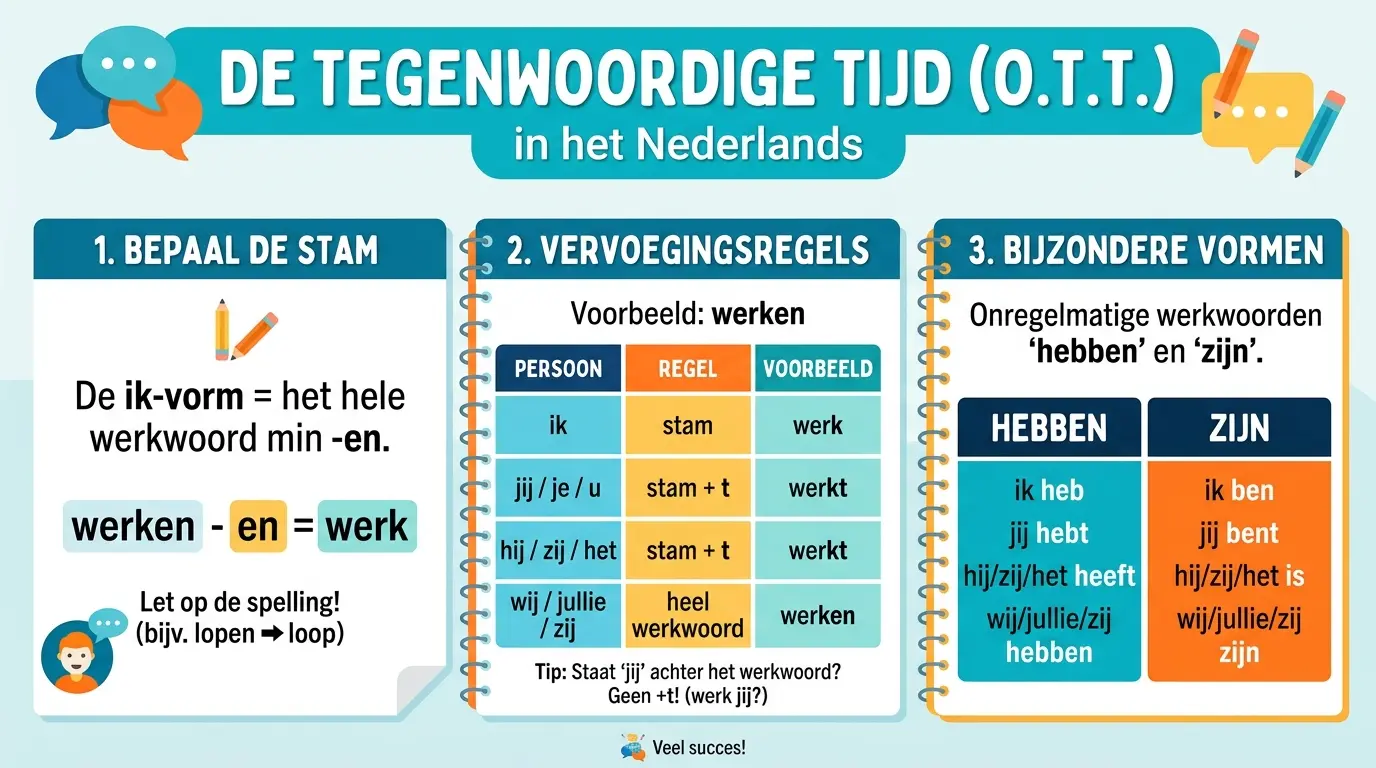
The Dutch present tense describes what happens now, what happens regularly and what is generally true. Its basic pattern is stem, stem + t, or infinitive, depending on the subject. Most verbs follow this pattern; frequent verbs such as zijn and hebben have forms you need to learn separately.
Ik bestel een broodje. Mijn collega bestelt een salade. Wij bestellen samen.
I order a sandwich. My colleague orders a salad. We order together.
When do you use the Dutch present tense?
The full grammatical name is onvoltooid tegenwoordige tijd, abbreviated to OTT. Unlike English, Dutch does not require a choice between a simple and a continuous form for every present action: Ik werk can mean “I work” or “I am working”. The context, often a time expression, tells you which meaning is intended.
The present can also refer to the future when the time is clear: Volgende maand verhuis ik naar Breda — “I am moving to Breda next month”. You do not need zullen merely because the event is in the future. To emphasise an activity in progress, Dutch also has zijn + aan het + infinitive: Ik ben aan het koken — “I am cooking”. This is useful, but not compulsory for every action happening now.
Regular verbs: stem, -t and infinitive
Start with the infinitive, the dictionary form, such as werken. For a regular verb, the stem is the form used with ik: werk. Use the table below for ordinary subject–verb order. Short and full pronouns follow the same conjugation: je behaves like jij, we like wij, and ze like zij.
| Subject | Pattern | werken |
|---|---|---|
| ik | stem | ik werk |
| jij / je | stem + t | jij werkt |
| u | stem + t | u werkt |
| hij / zij / ze / het | stem + t | zij werkt |
| wij / we | infinitive | wij werken |
| jullie | infinitive | jullie werken |
| zij / ze | infinitive, plural | zij werken |
Zij/ze can mean “she” or “they”; the verb shows the number: ze werkt versus ze werken. The polite pronoun u takes the singular verb form even when you address several people. Noun subjects follow the same agreement rules: de winkel opent, but de winkels openen.
How to find and spell the stem
For most verbs, remove -en from the infinitive, then check the spelling. Simply cutting off the final two letters is not always enough. Dutch spelling preserves the vowel sound: a long vowel may need two letters in the stem, while a doubled consonant becomes single at the end of the word.
| Spelling rule | Infinitive → stem | With hij |
|---|---|---|
| No spelling change | werken → werk | hij werkt |
| Keep the long vowel | maken → maak | hij maakt |
| Remove the doubled consonant | bellen → bel | hij belt |
| Final v becomes f | leven → leef | hij leeft |
| Final z becomes s | reizen → reis | hij reist |
With leven → leef, two adjustments happen together: the long vowel is written ee, and final v becomes f. In the plural, use the full infinitive again: wij leven, wij reizen. Forms such as leef and reis are predictable spelling adjustments; they do not make these verbs irregular in the present tense.
Stems ending in t or d
If the stem already ends in t, do not add a second t: wachten → wacht → hij wacht. If it ends in d, add the regular -t: vinden → vind → hij vindt. You cannot reliably hear the difference between vind and vindt, so determine the subject and apply the ending rule.
Jij/je after the verb: when does -t disappear?
When jij or je is the subject and comes after the verb, the regular -t ending disappears. This happens in questions and when another sentence element comes first: jij werkt → werk jij? and Vandaag werk jij thuis. The rule is specific to jij/je; it does not apply to u or hij.
Vind je deze stoel comfortabel? Vindt u deze stoel comfortabel?
Do you find this chair comfortable? The second question uses the polite form u.
Only the ending disappears, not a t that belongs to the stem: jij wacht → wacht jij? A nearby je is not necessarily the subject either. In Werkt je buurman vandaag?, the subject is je buurman — “your neighbour”. Here je means “your”, so werkt keeps its -t.
Irregular verbs: zijn and hebben
Zijn means “to be”; hebben means “to have”. Their singular forms do not follow the ordinary pattern throughout. Learn the complete set, including ben je? and heb je? with inversion. For u, both hebt and heeft are correct; u bent is the usual form of zijn.
| Subject | zijn | hebben |
|---|---|---|
| ik | ben | heb |
| jij / je | bent | hebt |
| u | bent | hebt / heeft |
| hij / zij / het | is | heeft |
| wij / jullie / zij | zijn | hebben |
| Question with jij/je | ben je? | heb je? |
| Question with u | bent u? | hebt u? / heeft u? |
Other frequent special forms
Short infinitives such as gaan, staan, doen and zien need special attention: ik ga, ik sta, ik doe, ik zie. Their third-person forms are gaat, staat, doet, ziet. With an inverted jij/je, use ga je, sta je, doe je, zie je. The plural is the infinitive: wij gaan, staan, doen, zien.
Some modal verbs have exceptional singular forms too. The table shows the accepted variants with the subject before the verb. A slash separates alternatives: both forms are correct. Jij kan, jij zal and jij wil are also correct, as are the corresponding forms with u. In the Netherlands, kunt, zult and wilt are generally more neutral in formal writing.
| Infinitive | ik | jij / u | hij / zij / het | Plural |
|---|---|---|---|---|
| kunnen | kan | kunt / kan | kan | kunnen |
| mogen | mag | mag | mag | mogen |
| moeten | moet | moet | moet | moeten |
| willen | wil | wilt / wil | wil | willen |
| zullen | zal | zult / zal | zal | zullen |
When jij/je follows the verb, use kun je / kan je, wil je, zul je / zal je. With u, both variants remain possible: kunt u / kan u, wilt u / wil u, zult u / zal u. The difference is visible with willen: wilt jij? is incorrect, but wilt u? is correct. In the third person, use hij wil, without -t. Moeten follows the ordinary present-tense pattern: its stem already ends in t.
| Verb | Question with jij/je | Question with u |
|---|---|---|
| kunnen | kun jij/je? / kan jij/je? | kunt u? / kan u? |
| willen | wil jij/je? | wilt u? / wil u? |
| zullen | zul jij/je? / zal jij/je? | zult u? / zal u? |
An irregular past tense does not necessarily imply an irregular present. For example, komen has ordinary present endings: ik kom, jij komt, wij komen. Learn present forms according to their actual pattern, rather than assuming every verb from an irregular-verb list changes unpredictably in every tense.
Present-tense word order and separable verbs
In an ordinary main statement, the conjugated verb takes the second position. This means the second sentence element, not necessarily the second word: Na de lunch belt Eva haar klant. In a yes/no question, the verb comes first: Belt Eva haar klant? In a subordinate clause with one verb, it goes towards the end: Ik weet dat Eva haar klant belt.
A separable verb follows the same endings, but its prefix separates in a main clause: ophalen → ik haal … op, zij haalt … op. In a subordinate clause, the parts are written together. With a modal verb, the separable verb stays in the infinitive: Ik moet het pakket ophalen. The modal verb carries the present-tense ending.
Ik haal het pakket vanmiddag op. Ze weet dat ik het pakket vanmiddag ophaal.
I am picking up the parcel this afternoon. She knows that I am picking up the parcel this afternoon.
Common present-tense mistakes
| Instead of… | Use… | Why? |
|---|---|---|
| Ik maakt een afspraak. | Ik maak een afspraak. | Ik takes the stem. |
| Hij vind de ingang. | Hij vindt de ingang. | Stem vind + t. |
| Werkt jij op vrijdag? | Werk jij op vrijdag? | No ending -t before subject jij. |
| Werk u op vrijdag? | Werkt u op vrijdag? | U keeps the -t ending. |
| Wij reist samen. | Wij reizen samen. | The plural uses the infinitive. |
| Zij wilt eerder beginnen. | Zij wil eerder beginnen. | Third-person singular: wil. |