



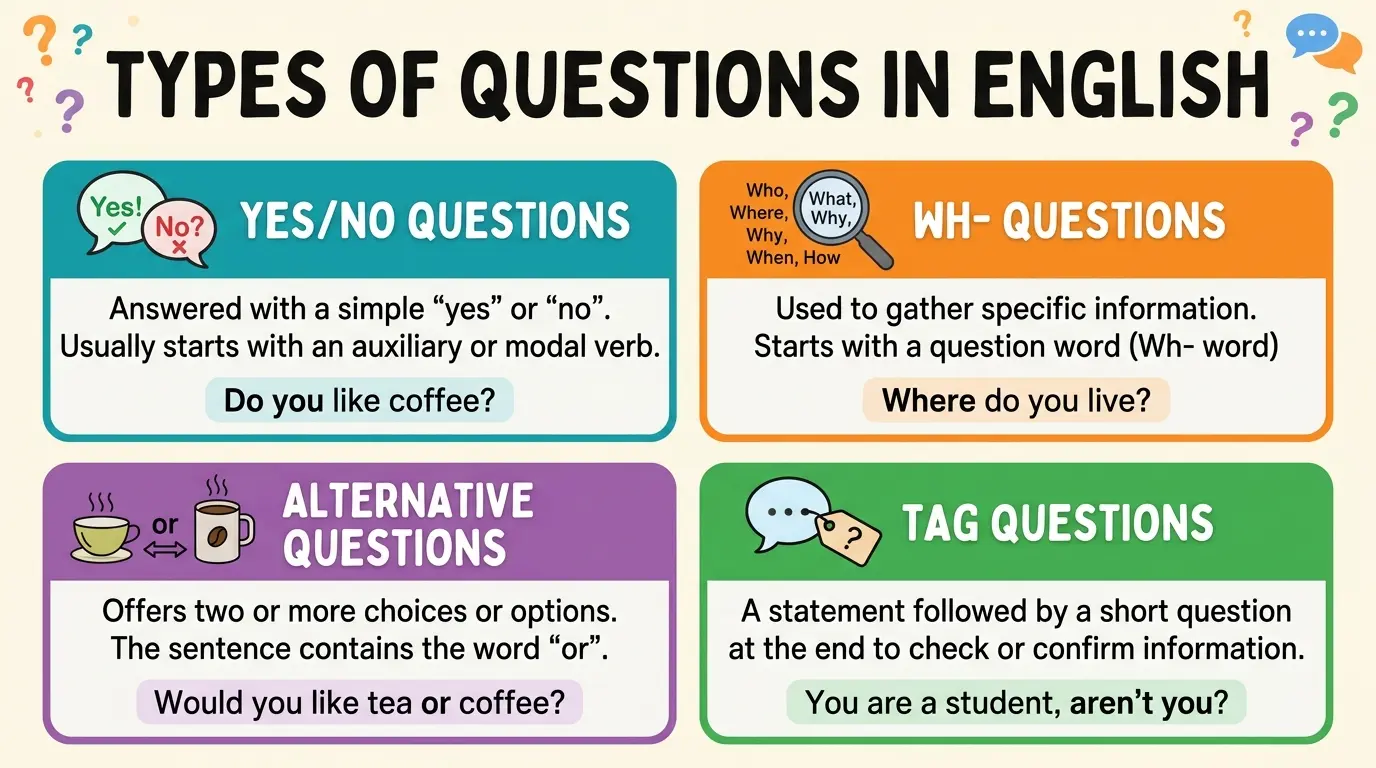
English questions can ask for confirmation, missing information or a choice. A short question tag can also turn a statement into a request for agreement or confirmation. These purposes use different patterns. The key is to identify the question type, then choose the right auxiliary and word order.
The four main question types
| Type | Example | Expected answer |
|---|---|---|
| Yes/no | Do you work remotely? | Yes or no, often with details. |
| Wh- | Where do you work? | Specific information: At home. |
| Alternative | Do you work at home or in an office? | A choice: At home. |
| Tag | You work remotely, don’t you? | Confirmation or correction. |
Yes/no questions: auxiliary before subject
For an ordinary yes/no question, use auxiliary or modal + subject + remaining verb forms. Move only the first auxiliary: She has been waiting → Has she been waiting? If be is the main verb, it goes before the subject itself: The door is open → Is the door open? Do not add do to these patterns.
When a present simple or past simple statement has no auxiliary, add do, does or did. Use does with he/she/it in the present and do with the other subjects; did works with every subject in the past. The main verb then takes its base form: Does he live here?, not “Does he lives here?”; Did they leave?, not “Did they left?”
| Verb pattern | Question | Short answer |
|---|---|---|
| be | Is your colleague available? | Yes, she is. / No, she isn’t. |
| Present simple | Do you need a receipt? | Yes, I do. / No, I don’t. |
| Past simple | Did Tom confirm the booking? | Yes, he did. / No, he didn’t. |
| Present perfect | Have they arrived? | Yes, they have. / No, they haven’t. |
| Modal | Can you hear me? | Yes, I can. / No, I can’t. |
In a short answer, repeat the relevant auxiliary or modal, not the main verb. Adjust the pronoun to the person answering: Are you ready? — Yes, I am. An affirmative short answer ends with the full verb form: Yes, she is, not “Yes, she’s”.
Wh-questions: ask for specific information
Most wh-questions use question word or phrase + auxiliary/modal + subject + main verb: Where did you park? With main-verb be: Why is the station closed? A question phrase can contain several words: How many bags are you taking? Keep the whole phrase together at the beginning.
| Word or phrase | Asks about | Example |
|---|---|---|
| who | A person | Who invited you? |
| what / which | Information / a choice within a set | What do you need? / Which seat would you prefer? |
| whose | Possession | Whose jacket is this? |
| where / when / why | Place / time / reason | Where do you study? / When does it start? / Why did you stop? |
| how | Manner or condition | How did you fix it? |
| how many / how much | Countable quantity / amount or price | How many tickets do we need? / How much does it cost? |
| how often / how long | Frequency / duration or length | How often do you travel? / How long is the meeting? |
Which usually points to a limited or understood set of options; what is more open. Whose asks about possession and is different from who’s, the contraction of who is or who has. In everyday English, a preposition often stays at the end: Who are you waiting for? The formal alternative For whom are you waiting? is grammatical but uncommon in casual conversation.
Subject questions: when do is unnecessary
When who, what or a question phrase is itself the subject, an ordinary affirmative question does not need do/does/did. Use question subject + verb: Who sent the file? But when you ask about the object, keep the usual question pattern: Who did you call? Here you is the subject. Existing auxiliaries remain: Who has opened the window?
This is not a ban on do in every subject question. Negatives need it with ordinary simple-tense verbs: Who didn’t receive the invitation? Emphatic do is also possible, but it adds contrast or insistence rather than forming a neutral question.
Alternative questions: offer a choice with or
An alternative question offers options joined by or: Would you like tea or coffee? A natural answer names an option: Coffee, please. You can also answer Either is fine or Neither, thanks. A simple yes does not identify a choice.
Alternatives can be nouns, times or actions: Are we meeting on Monday or Tuesday?, Should I call or send a message? In a typical spoken choice question, the voice rises on the first option and falls on the last. Not every question containing or is a choice question: with rising intonation, Do you have a pen or a pencil? can simply ask whether either is available.
Tag questions: choose the auxiliary and pronoun
A question tag follows a statement after a comma: The train is late, isn’t it? In the basic confirmation pattern, an affirmative statement takes a negative tag and a negative statement takes an affirmative tag. The tag repeats the first auxiliary or modal and uses a matching subject pronoun. With main-verb be, use be; with an ordinary simple-tense verb, use do/does/did.
| Statement + tag | Why this form? |
|---|---|
| Maya works here, doesn’t she? | Present simple, she: does. |
| They didn’t book online, did they? | Negative past simple: affirmative did. |
| You have seen this film, haven’t you? | Repeat the auxiliary have. |
| Leo can swim, can’t he? | Repeat can; replace Leo with he. |
| The room isn’t ready, is it? | Negative be: affirmative is. |
With a rising tone, the tag often asks for genuine confirmation; with a falling tone, the speaker is more confident and expects agreement. These are common patterns, not a guarantee of the speaker’s intention. Positive–positive tags also exist, often for reactions or surprise, but they are different from the basic confirmation pattern above.
Question tags that need special attention
| Case | Example |
|---|---|
| I am | I’m on the list, aren’t I? / I’m not late, am I? |
| Let’s | Let’s take a break, shall we? |
| Request or instruction | Close the door, will you? |
| There | There is a spare key, isn’t there? |
| never / nobody | She never drives, does she? / Nobody called, did they? |
| everyone / something | Everyone is ready, aren’t they? / Something is wrong, isn’t it? |
Never and nobody already make a clause negative, so they take an affirmative tag. Use they for people referred to by everyone, someone or nobody; use it for something or nothing. After an imperative, will you is a common tag, but its tone can make a request friendly or impatient. It is not the only possible imperative tag.
Answer according to the facts, even after a negative statement: You don’t eat meat, do you? — Yes, I do means you eat meat; No, I don’t means you do not. A full short answer avoids ambiguity.
Direct and indirect questions: a different word order
Inside an indirect question, use statement order: Where is the exit? → Could you tell me where the exit is? For a yes/no question, introduce the embedded clause with if or whether: Do you know if the shop is open? The opening clause forms the question; do not repeat question inversion inside it.
Common mistakes in English questions
| Incorrect in this pattern | Correct | Reason |
|---|---|---|
| Does she speaks French? | Does she speak French? | Base form after does. |
| Where you did stay? | Where did you stay? | Auxiliary before subject. |
| Who did sent this? | Who sent this? | Neutral subject question. |
| She can help, doesn’t she? | She can help, can’t she? | Repeat the modal. |
| Do you know where is he? | Do you know where he is? | Statement order in the embedded clause. |