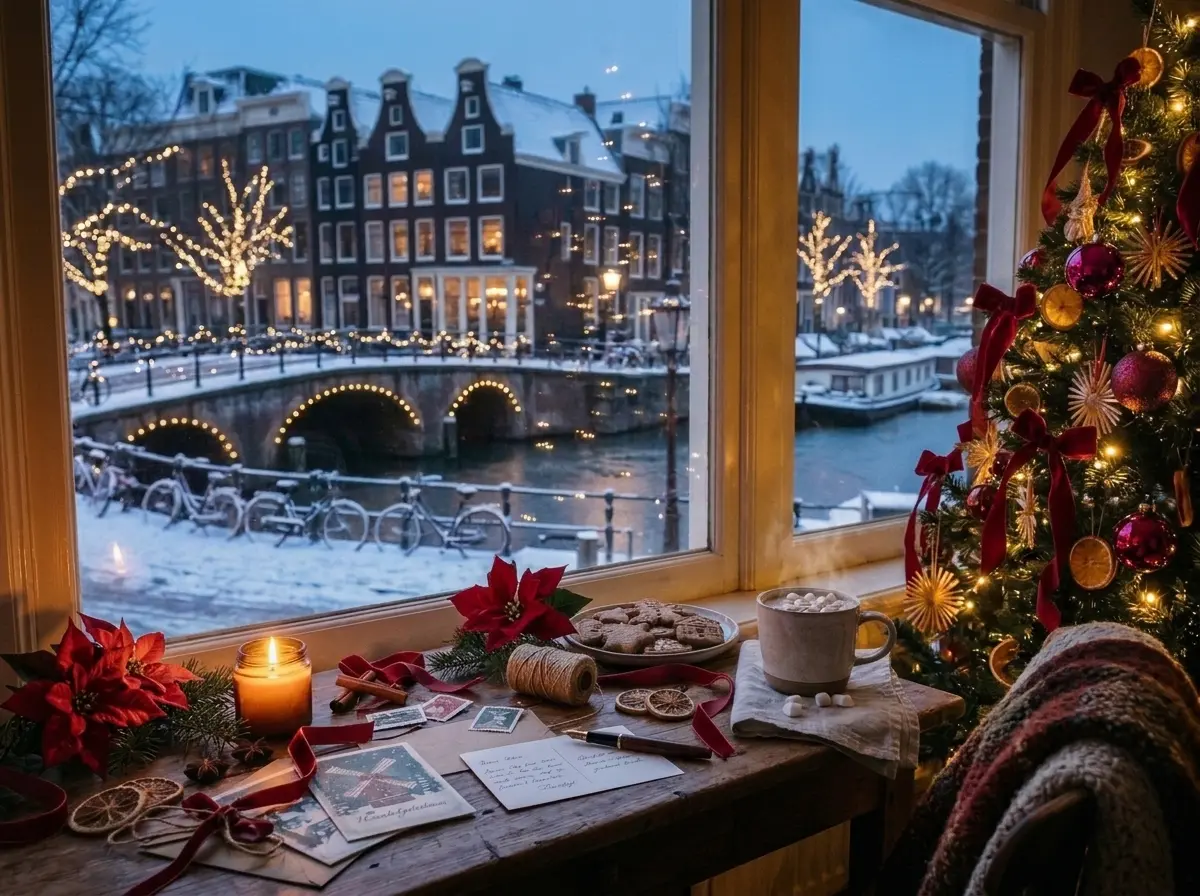
On the last evening of December, a warm house feels especially welcoming. There is a plate of oliebollen dusted with icing sugar, friends are arriving, and midnight is still a few conversations away. This is one way to spend New Year’s Eve in the Netherlands. The next morning, some of those celebrating will head for the coast — and run straight into the cold sea.
Dutch New Year celebrations have their own food, familiar rituals and everyday expressions. Knowing a few of them makes it easier to join in, whether you are ordering a treat from a stall or spending the evening with Dutch friends.
1. What does oud en nieuw mean?
You will often hear the celebration called oud en nieuw, literally ‘old and new’. It covers saying goodbye to one year and welcoming the next. Oudejaarsavond means New Year’s Eve, nieuwjaarsdag is New Year’s Day, and jaarwisseling refers to the turn of the year.
Asking about plans
Wat ga je doen met oud en nieuw?
What are you doing for New Year?
We vieren het thuis met vrienden.
We’re celebrating at home with friends.
There is no single way to celebrate. Some people host friends, some go to a party, and others prefer a quiet evening together. If you receive an invitation, check when to arrive and whether it includes dinner. An evening gathering may start after everyone has eaten.
2. Oliebollen: the taste of a Dutch New Year
As the year draws to a close, queues form at oliebollen stalls. Oliebollen are deep-fried balls of dough served with icing sugar, with or without raisins. A fresh one has a thin crust and a soft centre. Take care with that first bite outside: the sugar has a habit of landing on your coat.
You may also find appelbeignets on the table: apple rings dipped in batter and fried. Try a little of each if you are curious, but leave some room — oliebollen are filling.
At a food stall
Mag ik twee oliebollen zonder rozijnen, alstublieft?
Could I have two oliebollen without raisins, please?
At someone’s home
Heb je ze zelf gebakken?
Did you make them yourself?
That second question is useful when your host serves homemade oliebollen. It gives them a chance to tell you about the recipe, and you have an easy conversation to go with your food.
3. How people spend the evening
At home, the hours before midnight might be filled with conversation, a board game or television. One established tradition is the oudejaarsconference, a comedy performance that looks back at the year through satire and topical jokes.
For a Dutch learner, understanding the words may only get you halfway to understanding a joke. The missing piece is often a news story or public figure. Ask Waar gaat deze grap over? — ‘What is this joke about?’ — and let someone explain the background. It can be an interesting glimpse into what people have been talking about.
Before visiting, a useful question is Zal ik iets meenemen? — ‘Shall I bring anything?’ Your host’s answer is a better guide than trying to guess which food or drink would be welcome.
4. Midnight greetings and celebrations
At midnight, the simplest greeting is Gelukkig nieuwjaar! Raise a glass of your preferred drink and say Proost! — ‘Cheers!’ You can keep your wishes short; a familiar phrase is all you need to join the moment.
| Dutch phrase | Meaning and use |
|---|---|
| Gelukkig nieuwjaar! | Happy New Year! Suitable for friends, neighbours and colleagues. |
| De beste wensen! | Best wishes for the new year! Also used when meeting people in early January. |
| Een gelukkig en gezond nieuwjaar! | Wishing you a happy and healthy new year! |
| Dank je wel, jij ook! | Thank you, you too! An informal reply to one person. |
| Dank u wel, u ook! | Thank you, you too! A polite, formal reply to one person. |
Fireworks have long been part of the Dutch New Year’s Eve scene, but older accounts no longer describe the rules. A nationwide consumer fireworks ban took effect on 1 August 2026, applying for the first time to the 2026–2027 celebrations. Category F1 is exempt, and professional displays remain possible. Check your town’s programme if you want to watch a display.
5. New Year’s Day: a very cold dip
Some people start 1 January with a slow breakfast. Others head out for a nieuwjaarsduik, a New Year’s dip, where participants gather and enter the cold water together. Scheveningen beach in The Hague is one of the best-known locations.
You can enjoy the atmosphere from the shore without taking the plunge. Check the organiser’s latest announcement before setting off, as bad weather can lead to cancellation.
Doe je mee aan de nieuwjaarsduik?
Are you taking part in the New Year’s dip?
Ik kom alleen kijken.
I’m just coming to watch.
6. Keeping the conversation going in January
The greetings do not end at midnight. When you see a colleague or neighbour in early January, De beste wensen! is an easy way to begin. You can follow it with Heb je een fijne jaarwisseling gehad? — ‘Did you have a good New Year’s celebration?’
A short answer is enough: Ja, we waren bij vrienden. Het was heel gezellig. — ‘Yes, we were at our friends’ place. We had a lovely time.’ Here, gezellig suggests both good company and a warm, relaxed atmosphere.
These small exchanges can become some of your favourite memories of the holiday: a neighbour wishing you well, a host sharing a recipe, or your first New Year’s greeting in Dutch. You do not need an elaborate speech to make someone glad you joined them.